Archaeological Excavation Results of the Phong Le Cham Tower Site (2011–2018)
The Phong Le Cham tower site is located in Group 4, Hoa Tho Dong Ward, Cam Le District, Da Nang City, at coordinates 16°00’08” N latitude and 108°11’55” E longitude. It is one of the most important Cham tower complexes, holding immense historical and cultural value in Da Nang.
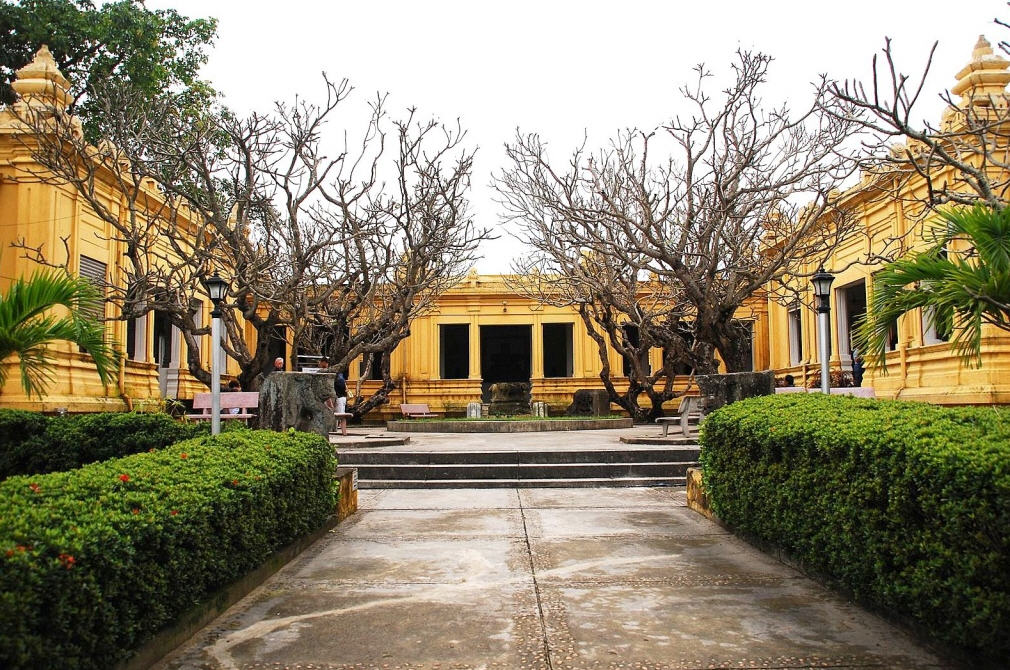
Over a century ago, the French established a plantation on the grounds of the Phong Le site. Consequently, several stone sculptures were collected by the French and relocated to the Tourane Park (now Da Nang). Later, these works were placed on display at the Henri Parmentier Museum (now the Museum of Cham Sculpture). The gathered collection includes a linga, corner decorative reliefs, a tympanum depicting Dancing Shiva, and three Vishnu reliefs—all exceptionally rare and fine sculptures of Champa art.
Following a long period of war, the site fell into ruin. After 1975, the local agricultural cooperative leveled a portion of the site to construct livestock shelters, and local residents gradually settled in the area.
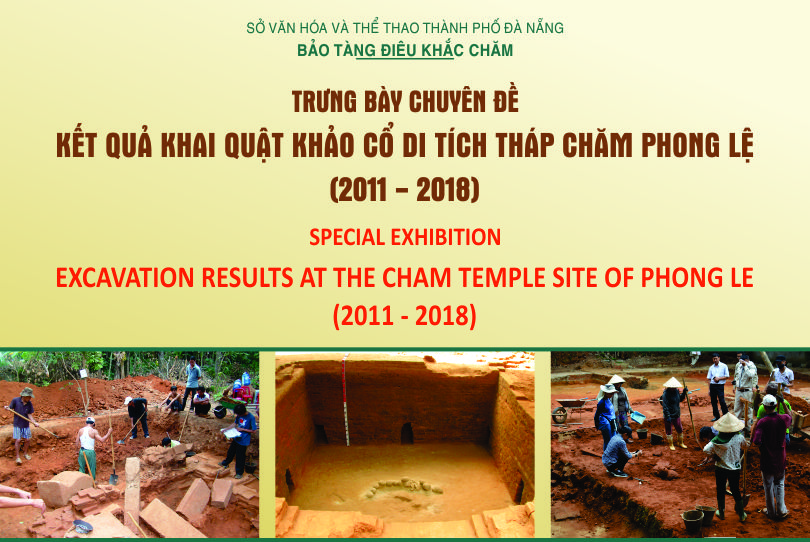
In April 2011, a local resident unearthed a sandstone lion statue while digging foundations for a home. To urgently protect the site, the Da Nang Museum of Cham Sculpture collaborated with the Faculty of History, University of Social Sciences and Humanities, Vietnam National University, Hanoi, to conduct an initial excavation covering 206 m2. Subsequent excavations were carried out over 275.5 m2 in 2012, and over a total area of 308 m2 in 2018. Across these three excavation campaigns, major findings were uncovered regarding the Phong Le site:
– Architectural Layout: The results reveal that the Phong Le temple complex consisted of a main sanctuary and a gate tower surrounded by an enclosure wall, built on a high mound near an ancient branch of the Cam Le River. Inside the main sanctuary, the interior architecture was built sunken underground to form a “sacred pit.” Its unique construction layout and artifact arrangement are rarely seen in other Champa temple excavations across Central Vietnam. Furthermore, auxiliary structures such as a long hall (Mandapa) and secondary shrines likely existed within the enclosure wall near the main tower. Overall, this was a large-scale monument within the known system of Champa temples in Central Vietnam.
– Artifacts: Nearly 400 artifacts made of various materials including stone, ceramics, quartz, and gold were discovered across the three excavations. Findings include animal statues (lions, elephants), roof edge decorations (praying figures, sacred snakes, antefixes/flame-shaped ornaments, heads, sacred birds, tower finials), as well as numerous roof tiles and carved bricks.
Archaeologists date the construction of the Phong Le Cham tower site to around the 10th century CE, with continuous worship maintained by the Champa people until at least the 12th century CE.