
Bodhisattva Tara
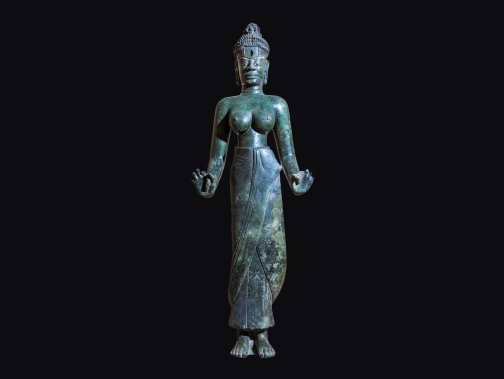
Dating: Late 9th – Early 10th century CE
Provenance: Dong Duong, Quang Nam Province
Inventory No.: 535/KL103
Material: Metal
In 1978, local residents accidentally discovered a bronze statue of a goddess standing nearly 1.15 meters tall. The goddess stands upright, with both arms extended symmetrically forward; her right hand holds a lotus blossom, and her left hand holds a conch shell. Her upper body is bare, featuring full, rounded breasts. Her lower attire consists of a long skirt reaching down to her ankles with an overlaid garment draped outside. Her square, stern face—characterized by thick, arched, intersecting eyebrows, a broad nose, and full lips—strongly evokes the Dong Duong artistic style. Her hair is bound into a high topknot adorned with an image of Amitabha Buddha. Based on these stylistic features, the iconographic attribute of the lotus in hand, and the depiction of Amitabha Buddha in the hair, scholars soon linked this statue to the principal deity Laksmindra Lokeshvara mentioned in inscriptions discovered at Dong Duong. The name “Tara” was suggested by researcher Jean Boisselier five years after the artifact’s discovery, and this designation continues to be a subject of discussion and debate among scholars. This masterpiece is recognized as one of the most significant bronze Tara statues in all of Southeast Asia.
Image Gallery