
Visnu
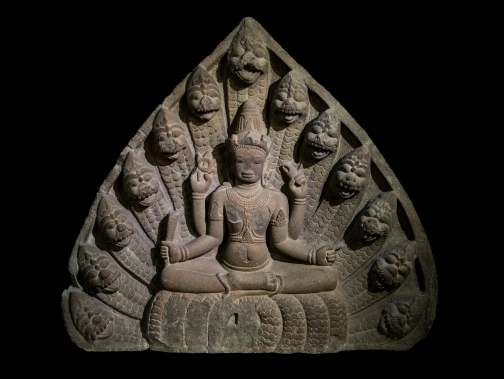
Dating: 7th–8th century CE
Provenance: Tra Kieu, Quang Nam Province
Inventory No.: BTC 142
Material: Sandstone
In Hindu mythology, Vishnu is a solar deity who traversed the universe in three strides, symbolizing the three phases of the sun: sunrise, noon, and sunset. As one of the principal deities of the Hindu Triad (Trimurti), Vishnu serves as the preserver and protector of the universe. While statues of Vishnu are relatively rare in Cham sculpture, they are consistently works of high artistic and aesthetic value.
This relief depicts Vishnu seated on the back of the mythical serpent Naga, whose body is coiled into nine sturdy rings to form a solid pedestal. Surrounding the deity, 13 snake bodies rise up, their 13 crowned heads fanning out into a protective canopy overhead. The four arms of Vishnu hold his sacred attributes: the mace (Kaumodaki), representing the power of knowledge; the discus (Chakra), symbolizing the solar wheel with its rays and the twin powers of creation and destruction; the conch shell (Shankha), signifying the origin of life; and a lotus blossom (Padma) or a sphere (now broken). Furthermore, these four attributes symbolize the four primordial elements of the universe: earth (mace), fire (discus), wind (conch), and water (lotus).