Siva
Dating: 10th century CE
Provenance: Phong Le, Da Nang
Inventory No.: BTC 84
Material: Sandstone
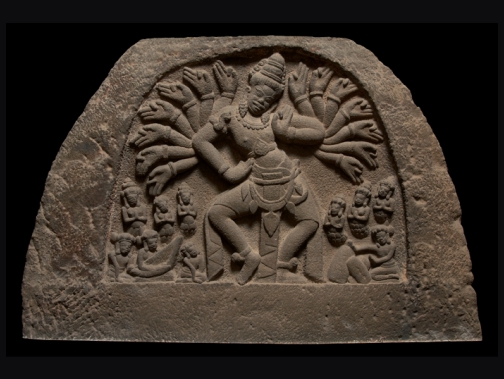
This masterpiece depicts Shiva in the form of Nataraja (the Cosmic Dancer), representing his supreme cosmic power and serving as the most complete manifestation of the deity. The name Nataraja derives from Sanskrit: Nata meaning “dance” and Raja meaning “king” or “lord.”
According to Hindu mythology, at the end of each cosmic cycle, Shiva as Nataraja performs his divine dance to destroy the exhausted cosmos, paving the way for the creation of a new universe. The two primary forms of this cosmic dance are Tandava—a violent, intense dance associated with destruction—and Lasya—a gentle, graceful dance associated with rebirth and creation. Lasya is performed following Tandava, in response to his divine consort, Goddess Parvati. In essence, Tandava and Lasya embody the dual nature of Shiva: destruction to enable rebirth and cosmic renewal.
In Champa stone carving, Shiva Nataraja performing the Tandava dance is rendered in an exceedingly graceful and fluid S-shaped posture (tribhanga). The deity wears a distinctive three-tailed sampot—one pleat in front and two behind, folded in a dynamic zigzag pattern—accented by an outer decorative belt adorned with five leaf-shaped pendants (likely representing precious metal ornaments). Below, six Naga serpent figures emerge from the cosmic ocean, their hands joined in reverent worship of Shiva’s sacred dance, accompanied by a musical ensemble of two singers and two instrumentalists. One musician plays an arched harp, while the other beats a set of three drums resembling the traditional Gineng drums played by the Cham people today.
This iconic artifact was featured in major international exhibitions at the Guimet Museum (France) in 2005 and the Museum of Fine Arts, Houston (USA) in 2009.
Hình ảnh