My Son E1 Altar
Dating: 7th–8th century CE
Provenance: My Son, Quang Nam Province
Inventory No.: BTC 6
Material: Sandstone
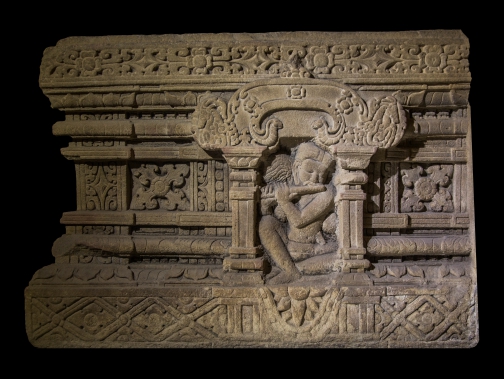
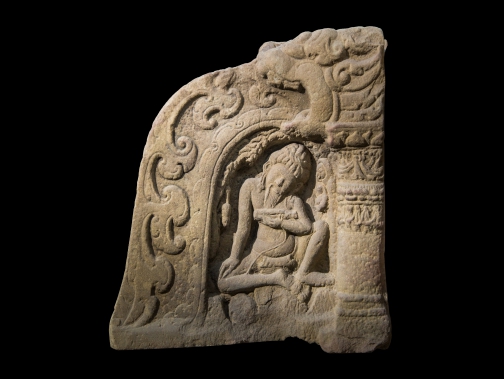
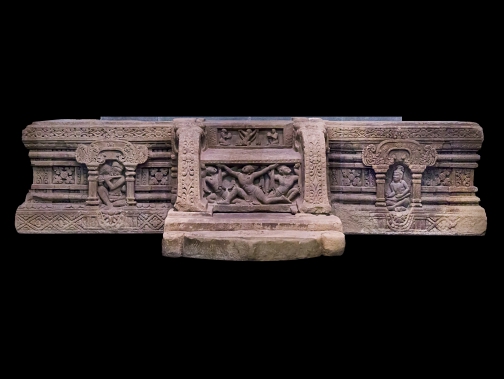
The altar originally comprised 16 carved stone blocks, 14 of which remain today as 2 blocks were lost following excavation. It originally supported a sandstone Linga–Yoni pair, which has since been lost. This is the only surviving pedestal discovered to date that faithfully mimics the architectural and decorative features of a Cham temple tower, including stepped tiers, door arches, pilasters, faunal motifs, and floral patterns. Most notably, it features depictions of Hindu ascetics meditating in the forest, living in harmony with nature and wild animals. At the front step, six dancers are portrayed performing a sacred scarf dance in offering to the divine. In Hindu mythology, Mount Meru serves as the abode of the gods, with Shiva reigning atop its peak. The My Son E1 Altar functions as an architectural representation of Mount Meru, with the Linga–Yoni enshrined above symbolizing Lord Shiva.
The decorative border framing the altar features repeating diamond motifs interspersed with four-petaled blossoms. This ornamental style also appears on several sculptural works from the Mon–Dvaravati art tradition of Thailand dating to the 7th–8th centuries CE.
This pedestal was officially recognized as a National Treasure in 2012.
Hình ảnh