Khương Mỹ Altar
Dating: 10th century CE
Provenance: Khuong My, Quang Nam Province
Inventory No.: BTC 63
Material: Sandstone
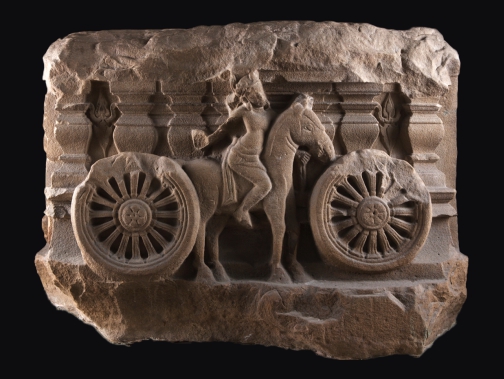
The narrative carved on this pedestal represents a rare iconography in Cham sculptural art. The square altar features two horse-drawn chariots on two of its faces, while the remaining two faces depict a lotus blossom and a turtle. The driver of the chariot wears a sampot in the Tra Kieu style, yet his thick mustache remains a retained characteristic of the earlier Dong Duong style.
According to Hindu mythology, in addition to his role as the preserver of the universe, Vishnu is associated with pastoral life as a cowherd, often riding a chariot following cattle across vast pastures. The turtle represents Kurma, one of the famous avatars of Vishnu, while the lotus is a sacred attribute held by the goddess Lakshmi, the consort (Shakti) of Vishnu. Furthermore, archaeological excavations at the Khuong My towers revealed numerous monkey statues decorating the bases of the structures. Monkeys in Cham art represent Hanuman, the loyal deity and devotee of Prince Rama (an avatar of Vishnu). Thus, this pedestal was likely dedicated to the worship of Lord Vishnu—a deity relatively less frequently venerated in Champa compared to Shiva.
Hình ảnh