Altar
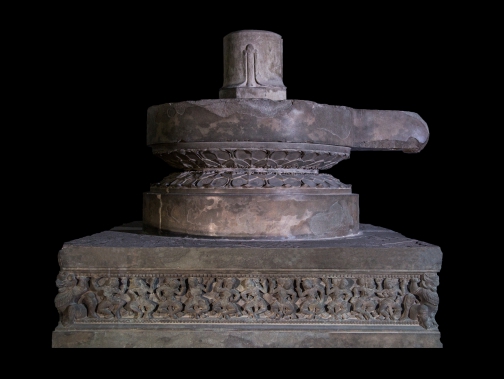
Tra Kieu Altar (Tra Kieu Pedestal)
Dating: 7th–8th century CE
Provenance: Tra Kieu, Quang Nam Province
Inventory No.: BTC 95
Material: Sandstone
For the Cham people, the altar served as a conduit connecting the divine with the sacred tower, linking heaven and earth. Placed at the center of the main sanctuary, the altar typically supported a Linga–Yoni or a devotional image dedicated to the principal deity of the temple. Each altar conveys distinct artistic styles and iconographic meanings.
The Tra Kieu Altar consists of the following components: at the top rests a Linga; in the middle is a Yoni base comprised of two circular moldings adorned with stylized, symmetrical lotus petals; below sits a square pedestal base. The four faces of this square block are carved with high-relief figures—Faces A and B depict 16 figures each, Face C features 18 figures, and Face D presents 11 figures. At the four corners of the altar, four crouching lions raise their forelegs to support the upper structure. Positioned between the two circular moldings of the Yoni was originally a third circular ring carved with a row of female breasts, which has since been lost.
The Tra Kieu Altar is universally recognized as one of the supreme masterpieces of sculpture. Immediately following its discovery, it attracted numerous scholars seeking to decode the narrative carved around its sides and to determine its precise chronology.
According to Jean Przyluski, the four scenes around the altar depict the legend of the founding of Funan.
According to George Cœdès, the narrative illustrates episodes from the life of Krishna, specifically Krishna curing the hunchbacked woman Trivakra and snapping the divine bow of King Kamsa.
Later, scholar Tran Ky Phuong proposed that the four sculpted reliefs depict key episodes from the Ramayana epic. According to the Ramayana, King Janaka of Videha had long been married to his queen but had no children. Legend tells that during a royal plowing ceremony at the start of the year, as King Janaka turned the first furrow, a newborn baby girl emerged—a gift bestowed upon the king by Mother Earth. The king named the child Sita. When Sita reached womanhood, King Janaka arranged a contest for her suitors: whoever could string the divine bow given by Rudra, the storm god, would win Princess Sita’s hand in marriage. Numerous princes tried and failed to string the bow. Ultimately, Prince Rama not only strung the bow but snapped it in two. King Janaka subsequently bestowed Princess Sita upon Prince Rama in marriage.
The sequence of the four faces is interpreted as follows: Face D faces the courtyard; moving clockwise to the left of Face D is Face A, followed by Faces B and C. The narrative progresses clockwise from Face A to Face D: Face A depicts Prince Rama breaking the divine bow of Rudra; Face B portrays Rama and his retinue presenting gifts to King Janaka; Face C illustrates the bridal procession; and Face D shows Apsaras dancing in celebration of the wedding between Prince Rama and Princess Sita.
Relocated to the Museum in 1901, the Tra Kieu Altar is currently designated as one of six National Treasures housed within the collection of the Da Nang Museum of Cham Sculpture.
Image Gallery